
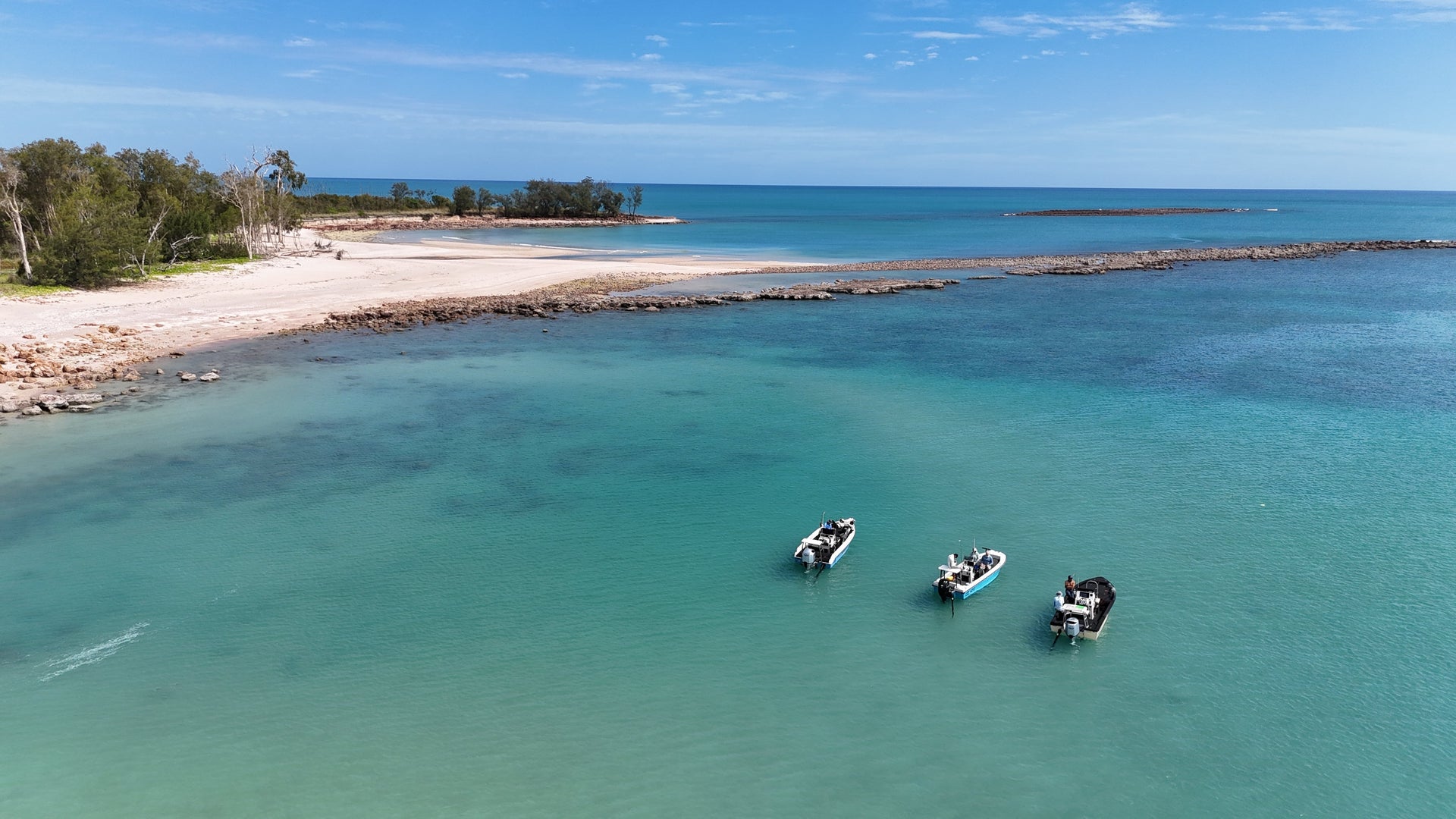
We are together for five days, fishing from dawn until late, eating at the same table and sleeping in the same room. Our closeness is unusual, because we live far from each other—George in Wellington, Dylan in Sydney, and me in Dunedin. Our days are filled with fun. Something that is perhaps uncomplicated for my two grandsons, but for me it is bittersweet, because it magnifies how much I miss them when we aren’t together. There is something else, less easily explained. Moments of joy watching them acquire new skills, seeing them entranced by the sea, the fish and the wildness of the place. All of it made more precious by knowing these times together are as ephemeral as the lives of mayflies.
George is fifteen and Dylan soon to be thirteen. For them it is a time of growth and change. I learn George’s new voice, broken by puberty and distorted by the braces wrangling order into his teeth. He jokes with me about my lack of hair, and I can’t bring myself to say his genes might remove his brown mop, the front of which hangs over his forehead like a veranda. He is already taller than me, with long slender legs flecked with blond sun-bleached hairs. He grows quickly and is as lean as a whippet.
Dylan has dense liquorice black hair with no hint of a curl, and is, like his mother, so olive skinned he could be mistaken for someone from Spain. His brown eyes, set in a pool of white, sparkle with mischief and warmth. He moves with the grace of an athlete.
We had fished together before—back in 2019, when we camped beside the Mataura River. It is where they caught their first trout, but it was just for a couple of days, and home wasn’t far away—the stakes were higher this time. On this tropical peninsular roughly the size of England, and home to twenty thousand people, and around twelve thousand crocodiles, I am responsible for their safety.
The three of us fly north to Cairns and our final destination, Weipa, the small mining town that sits on a sea of red dust, as fine as talcum powder in the dry, and as sticky as putty in the wet. I’ve often called the flight from Cairns to Weipa my favourite journey, but flying with the boys jolted my complacency about the landscape we are crossing. Their eyes hold the same excitement I experienced when I first saw this place over twenty years ago. Dense rainforest gives way to open savannah as we cross the northern remnant of the Great Dividing Range. Closer to our descent into Weipa, small impermanent lakes shine like mercury in the late sun, as do the threads of streams that join to form the vast, mangrove lined, estuaries that drain the summer rains. We arrive at the end of the wet season. There is a green flush on the land that will last until the winter dry begins.
Close to the runway we cross red scars on the land that extend as far as we can see—for this is the site of one of the largest deposits of bauxite on the planet. Thousands of hectares of land are being stripped of vegetation, a meter or so of topsoil removed, and the red pebbly dirt that is bauxite, scooped up and transported on ships to be converted into aluminium. In the West, aluminium is put to use mostly in cans, cars, cooking foil and aeroplanes, and is a product without which our lives would be quite different. The land below us is ground-zero for this enterprise. I don’t blight our adventure by telling the boys about my concerns for what this opencast mine—twenty kilometres across and fifty kilometres long—will do to the waters of the Gulf of Carpentaria.
For aeons, around two meters of rain has fallen each wet season, most of which soaks into the layer of porous bauxite, before slowly migrating to the gulf. I have spent decades looking at water, long enough to know what it will do when it encounters the layers of clay found under the bauxite. Without the bauxite to act as a filter, it will run off the land faster than before and likely take some of the soil with it, thus changing the delicate relationship between land and water.
 The shoreline of Cape York is lined with gum trees—mostly stringybarks and their more humorous cousins, the woollybutts—along with paperbarks and other native species that like the peninsula’s sandy soil. Photo: Dougal Rillstone.
We are up early and at the jetty by seven on our first morning, ready to fish with our aptly named guide, Fish, a flinty doyen of saltwater flyfishing in Australia, who has become a friend over the two decades he has guided me. These days he is partially retired, limiting his guiding to around twenty days a year, and while I’m flattered that he chose to guide us, I worry that his blunt style and weathered Chuck Norris looks might be too much for the boys.
We leave the harbour, headed south. I have left this harbour dozens of times, seen the water torn up by the collision of wind, tide, and swell, but today it is flat. Departure is always filled with hope and excitement for what might encounter, even though on this trip I will be a watcher, not a fisher. I sit on the front seat, leaning into the shoulders of my grandsons, the wind blasting our faces. I think about the many departures I shared with Rick and JD, and the times Sue joined me. They were the best of times, but today I can’t believe my good fortune, being with George and Dylan.
We pull up beside reddish brown bauxite cliffs and Fish watches the boys cast metal lures on unfamiliar gear, struggling at first to get the timing right. “We pay good money for those rods,” says Fish. “Let the bend of the rod do the work. You don’t need to muscle it.”
Sometimes their timing and power are balanced and the lures fly far in the right direction, but often their fingers lose hold of the line on delivery of the cast, and the lure lands in a flaccid pile near the boat. I want to help them but know this is something they need to work out for themselves. Dylan twists his mouth in deep concentration. Eventually they improve.
 Crocodiles, ever watchful, loom from the sands and in the water. The estuarine crocs call the ocean, estuaries, rivers, and swamps home, adding the thrill of danger to the boy's day. Photo: Kurt Rowlands.
We hear on the radio that fish are feeding close to the surface further south, and we race off to find them. “Holy moly, look at that shark,” says George, as a dorsal fin cuts through the surface. Soon we are surrounded by bull sharks because they have learned taking a hooked fish is the easiest way to feed. The boys land several queenfish. They are the perfect target due to their willingness to grab the lure and because once hooked they pull hard, jump high and land with a splash. Soon though, the sharks have their way with the hooked fish, smashing them close to the boat, leaving Dylan gasping at the mayhem.
In the mouth of Waldron Creek at the end of the day, the boys cast at queenfish chasing schools of tiny baitfish feeding in the peat stained water flowing from the swampy headwaters of the creek. Approaching castles of cloud threaten to engulf us, dulling the light. A group of fish slide past, almost invisible, but for the dull flashes of remnant light bouncing off their deep flanks. After decades of looking, I have learned how different fish reflect light. The flash from a queenfish is faster and has less depth than light that bounces off the side of a permit. The flash from the side of a golden trevally isn’t as silver as the slow splash of light from permit.“Hey, Fish, I saw some flashes at one o’clock. Pretty sure they’re permit.” Fish watches the shadowy movement of the fish. Says, “Not sure.” When the moon-like flash appears again, he says, “That’s them, alright.”
The boys ate from the permit shaped cake made for my 70th birthday. They know how deep my obsession with these fish runs. As the permit depart, George makes a long cast towards them, his lure landing in line with the path they follow, and for a moment I hope he hooks one, but they move on, lost to the darkness.
The storm which took half an hour to reach us crosses the harbour entrance fast, tearing up the water in its path. Dense cold air tumbles off the leading edge of the cloud, and in seconds the temperature falls. Soon wind driven rain hits us, light at first, then heavy. I expect the boys will stop casting and hunker down, away from the storm, but they carry on, casting, retrieving, casting again, into the maelstrom of wind and water. Water pours from their jackets and runs down their faces as they lean into the wind. George fishes on, hair plastered across his forehead while the anglers in a nearby boat watch. Dylan looks tiny against the forces that lash him. Their resilience astonishes me. I expect them to be weary, but their eyes are lit with the vitality of the moment. I see them growing up, and my eyes mist with pride.
Eventually Fish says we must move, and we charge into the storm, bouncing across the smashed surface into rain that hits like shards of glass.
 Fishing off the boat or casting close to shore? An anglers joke finds little to no legs in the calm deep waters of the bay. Photo: Kurt Rowlands.
We attempt to catch barramundi on our second day, using live bait in a narrow side channel of the Mission River. The morning starts with a search for the bait. The boys follow Fish as he stalks the tiny fish schooling close to the shore in a game of stealth, the fish wary of attack from larger fish out deeper, and the long-legged birds ghosting along the shallows. A crocodile watches us from the far bank before sliding into the water. Fish flings the cast net over the schools of fish shimmering and darting over the sand while the boys stand transfixed, then whoop with excitement as we gather the slippery fish from the net.
We enter a small channel where peat-stained water runs as slow as spilt honey through the avenue of mangroves closing around us, the windless heat almost unbearable. We spend hours not catching barras. The boys do land queenfish and shovelnose rays that dwarf them, and hook other fish that are too large to lift into sight.
 Left: George casts beside bauxite cliffs. Photo: Dougal Rillstone. Right: The Gulf of Carpentaria is alive with fish, making for a special kind of bait ball frenzy. Photo: Kurt Rowlands.
On our last day we are awake before five and speed south before sunrise under a cloudless sky. A gentle swell pushes in from the west but the water is unruffled by wind. Close to where the red bauxite cliffs meet the beach I see an odd disturbance on the water, as though a patch of wind has touched down on the otherwise smooth surface. Fish turns the boat towards the disturbance and as we get closer, we see frigate birds circling above water erupting in small explosions. The water is dark with schooling baitfish, pushed to the surface by the packs of queenfish slashing through them, backs breaking the surface—silver bars lit by the sun, the hapless bait, flying through the air. A slick of fish oil forms on the water where the bait is attacked, and the air smells of anchovies.
The boys cast towards the fish and hook up in an instant. Rods are lifted into a deep bend before they wind down on the fish. They swap positions on the boat as the fish tear away, threatening to tangle lines. These fish are larger than those caught on the first day. Dylan lifts and winds, trying to do as Fish has taught him. For a moment I think the fish is too big for him, but finally he has it to the boat. He can’t hold it by himself so Fish assists, while I get a photograph of the fish—over a meter long, with deep, silver flanks. Soon George joins him with another, almost as large.
For three hours we follow the feeding fish. They catch fish after fish which are landed without any being lost to sharks. Their rods are almost constantly bent by charging, leaping queenfish, their smiling faces lit with excitement. There is much lighthearted banter between them: about who landed the largest fish, and who caught the most.
At the end of the day we head north to Weipa, a track I’ve followed many times. The boat slices through the now rough water and a hot wind buffets our faces and tears at our clothing. I haven’t made a cast and yet it has been one of the most satisfying trips, seeing my grandsons experience the kind of fishing that has drawn me back to this place for over twenty years.
I’m reminded of the final ride back of a trip a decade or so ago, sitting beside a friend and extolling the thrill and beauty we had experienced, remarking also on how hard it is to accept that one day the ride back will be our last. I’m not thinking of stopping yet, but on this trip with George and Dylan I have experienced a different kind of ending, a passing on of knowledge and experience to the next generation. It’s an amalgam of happiness and loss, and I’ve come to terms with it. Through their excitement I saw the place as though I was there for the first time, immersed in the vitality of the experience.
 Surveying the competition from the shoreline, fish are a staple for the local crocs' dinner plans. Photo: Kurt Rowlands.
On our last night we share the dinner table with eight men, almost all of whom are older than me. It has been the same group each night, and while I worried at the start that the boys might be too noisy for this group of fishers, they are polite, clear dishes from the table, and listen to the life advice directed to them without rolling their eyes. I’m proud to be with them.
Back in the room we share I watch George overpower Dylan in an arm wrestle. “Your turn, Pop,” he says. I hesitate, doubting I should do it, mostly because George’s arms are boyish and slender. I don’t want to humiliate him. “Come on. Are you scared?” he says, grinning.
We sit facing each other, right hands gripped, eyes locked. “Tell me when you’re ready,” I say. Immediately I realise I have misjudged his strength. For a few seconds we are stalemated, arms vertical. I grunt with effort and can’t force his arm down. “It’s a draw,” I say, but he shakes his head, and we continue. For a moment I think he has me beaten, but I manage, with the last of my strength, to push his hand to the table. We laugh, but I don’t enjoy beating him. I catch his eye and feel a ripple of resentment, not directed at him but in the recognition of my decline, because I know this will be the last time I am stronger than him.


Dougal is a fly fisher and writer, living in Aotearoa, New Zealand. He is obsessed with fly fishing for trout in his home waters, and for permit, which have drawn him to the most remote tropical flats on the planet. His writing has been published in New Zealand, Australia, South Africa and the USA. His book, “Upstream On The Mataura, A Fly Fishers Journey To Source,” is an account of a foot journey from sea to source of his home river, the glorious, abundant, and now threatened Mataura River.