
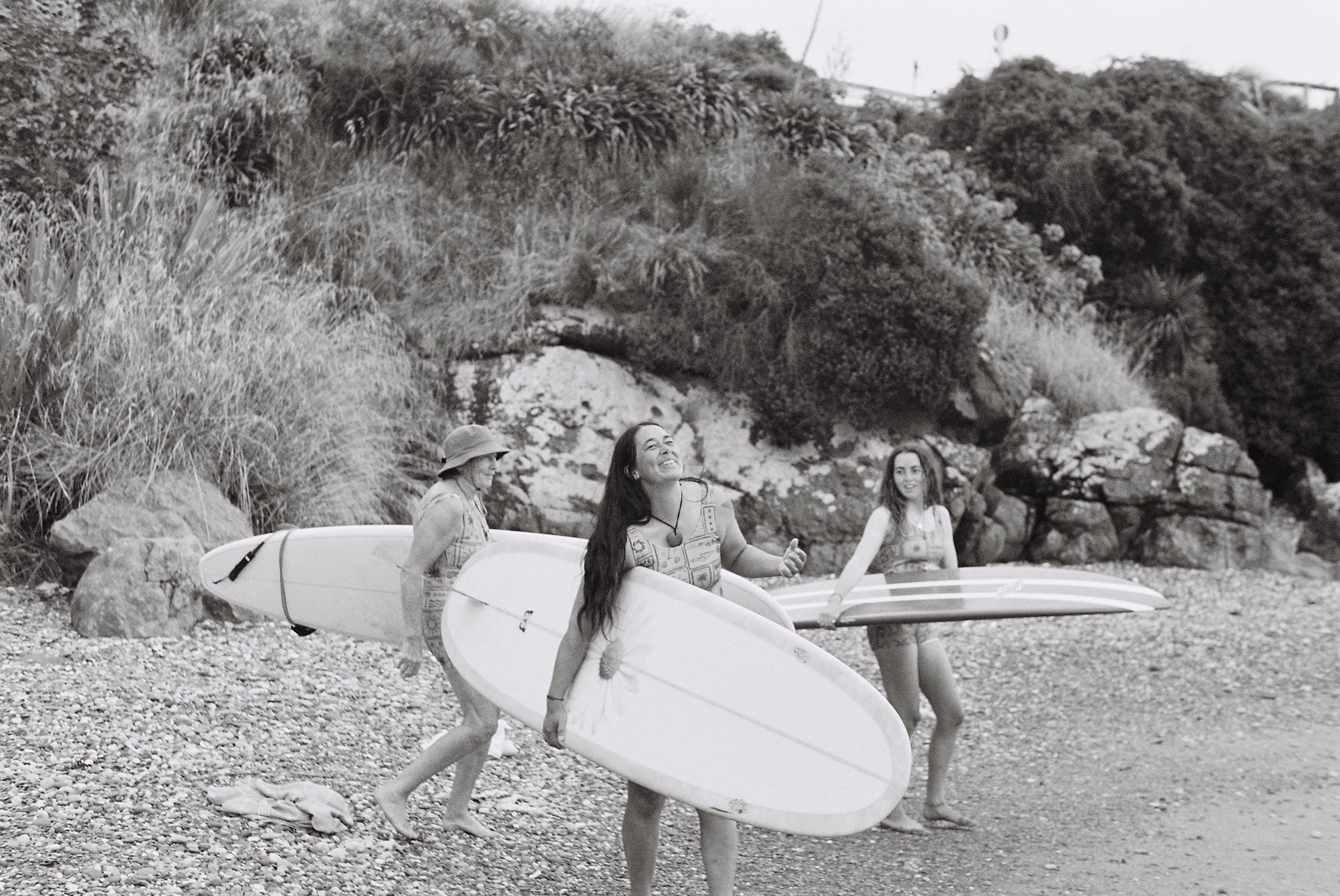
The first time I paddled out at Colac Bay, fingers numb and brain frozen, I heard the women of the Pou family before I saw them. Hooting, hollering, welcoming newcomers and dropping in on each other. This, I was to find out, was not an experience unique to me. The Pous are a surf dynasty in Riverton, but the kind of dynasty which flings the doors open for weekend blow-ins, and showers them in manaakitanga. They offer a reminder that surfing, at its best, is less about waves than who you share them with. The Pou women are three generations who surf together here: Yvonne, her daughter Marama, and her granddaughter Keita.
“Keita was like a little monkey on my back,” says Marama, nudging her daughter with her foot. “That’s how she learned.” Keita, now seventeen and a competitive shortboarder, can’t remember a time when she wasn’t riding waves. “I like dropping in on Nan best,” she says, grinning from the couch next to Marama, cup of tea and a biccie in hand, freshly delivered by Yvonne.
Looking at a photo of the three of them on a party wave, Yvonne shakes her head. “Agh, I wish I surfed when I was a kid, I’d be really good now,” she complains, and then laughs. She speaks fast, with the no-nonsense tone you associate with weathered, hardworking regions like Southland. Yvonne is from these parts originally. She married Puke - a surfer from Northland - who taught her to surf, and they moved to the sea. As soon as her youngest was old enough, Yvonne was surfing with her kids.

The Pou’s home break, which tidies heaving southerly swells into tidy right hand peelers. Photo: Zyanya Jackson.
Yvonne and Puke’s home in Riverton has, of all things, a wooden tram carriage as its central foundation. The walls of the carriage look like the hull of a boat, and they’re full: photos of smiling men with salted eyelashes and fish on hooks, long boards and beaming babies. I ask about the friendliness - is it a Pou thing, or a Riverton thing? Everybody is talking at once. “We are kind of friendly, I suppose,” shrugs Yvonne, “but it’s always been like that.”
“It’s just how we are, so we don’t really think about it,” Marama says. She is disarmingly frank, without a hint of pretence and with a hearty, dimpled smile that grows as she speaks. “People always say that the further south you go, the friendlier people get.”

“Keita’s the one dragging us out now - and she stays out the longest,” says Marama. “I think we definitely got some stubborn sassiness from my mum’s side.”
“Yep,” nods Keita, “One day in winter I was wearing no booties or hood and our friend Freddie was like,‘You get that from your mum!’” Photos: Amiee Freeman.
Earlier this year, Keita and Marama were on the South Island competition circuit; all the heats for Keita, four for Marama. But there was a time when surfing, much less competing, was off the cards for Marama. At the age of 35, with two young kids, she had a devastating stroke. A hole in her heart, the doctors told her. The right side of her body was temporarily paralysed; she had to re-learn how to walk, how to talk. They also told her not to get back in the water. That didn’t go down well. “I just don’t like it when people tell me I can’t do something,” Marama says. “So I like to prove them wrong and prove to myself I can do something.”
With her trust in her body shattered though, surfing was a daunting prospect. “I was terrified of everything - especially of it happening again. It was so frustrating. I was just sitting at home all the time, I couldn’t drive, I’d put on a lot of weight and was pretty depressed.” Enter Yvonne, who would arrive to get her out of the house, sitting with her in the water as she lay on her longboard. With her mum at her side, Marama, who had learned to surf before she was even at school, wobbled to a stand on her board once again.
She was unfit, self-conscious; but it felt like coming home. Surfing would prove essential to rebuilding her coordination and balance - that, and it brought life back into focus. “The things that used to matter to me don’t matter anymore, because those things aren’t important,” Marama says, turning to Yvonne. “It was reassuring having Mum there to encourage me. You might have pushed me, I can’t remember. I had lost a lot.”
“Confidence, mainly,” Yvonne cuts in. The two don’t look much alike, with Marama’s black hair and darker skin inherited from her Māori side. But I’m getting an idea of where she might get some of her tenacity. When I make this suggestion, Yvonne laughs. “Well, I always joke with girls who complain about being tired in the water. I’m like, ‘Just get on with it, you're forty years younger than me!’”
Marama nods. A gift from her mum, yes, but she’s also been shaped by what happened to her. “The big things you can’t control, they’re what make you who you are as a person. It’s taken me a long time, since getting back on my surfboard, to see that I can do things.”

“We’re at the bottom, so not a lot of people come this far,” says Marama. “And the ones that do usually like to share a wave!” Photo: Nush Freedman.

Contagious stoke; a family trait. Photo: Caitlin Hodgen.
If we follow the rule of increasing southerly friendliness, then it’s true: we must be at one of the most hospitable surf spots in mainland Aotearoa. Aparima (Riverton) sits at an estuary river mouth pressed up against Te ara A kiwa (Foveaux Strait), across from Rakiura/Stewart Island. Mitchell’s Bay, where the Pous live, is a longboarder's paradise of a right hand pointbreak.
On a good day, the surf around Riverton might be neat two-foot lines, feathering under glittering sunlight with Hector’s dolphins rippling through the line up. On most other days, it’s sideways rain and hail, with the occasional visit from a seven gill shark. The trees here are swept permanently into a sideways wail, hammered mercilessly by the prevailing wind. The average low in winter is 1℃; duck dives are icy, the water bites at fingers and toes.
The Pou women will be out in all of it. Sometimes without a wetsuit - or in Marama’s case, starkers. She's laughing almost too much to re-tell the story. “It was the middle of winter and my friend wanted to get some nude surfing photos.” She turns to Yvonne. “I was hoping you and dad wouldn’t show up. I was like, please don’t come please don't come. And you did! Just when I was getting out!” Laughter bounces around the room. “It wouldn’t worry me,” Yvonne says. “You hardly wear any wetsuit anyway.”
 “I was scared to go anywhere by myself,” says Marama of her time immediately post-stroke. “Of all the things I did, surfing was the one thing that made me feel good all the time. I feel free when I’m in the water - whatever I was grumpy about disappears.” Photo: Aimee Freeman.

“The other day someone said to me, ‘You must be getting too old for surfing,’” Yvonne says, shaking her head with disgust. “You’re never too old.” Photo: Zyanya Jackson.
Marama is open with the story of her stroke, sharing it to encourage those who might be feeling defeated in the water. “I like making it lighthearted, but also getting people thinking. If I can get through this, they can learn to surf.” This drive brought her into her role as Southland Ambassador for the Aotearoa Women’s Surfing Association, and, with Yvonne, to start a local Wāhine Wednesdays surf group.
Alongside a distinctive toughness, the Pou women share an irrepressible propensity for play, and the desire to spread it around - with a refreshing lack of ego. Riverton now has a flourishing crew of wāhine surfers. Many arrived as visitors, became friends and just…never left. “Mum used to not have many women her age to surf with,” Marama says, “but now there’s a few, eh Mum?”
 Yvonne cuts a familiar figure at Mitchell’s; if there’s a wave, she’s in the water. Photo: Aimee Freeman.
Friendship has, in fact, for Yvonne, been one of the richest rewards bestowed by a surfing life. “They’re not all my age, either. You meet all different people and it’s really cool,” she says. For those who ask, she’s always happy to take a newbie under her wing, including her sister, at age 60, who in her first session, was flying down the line.
The light is fading over Mitchell’s, which today is flat, chafed into wind chop. We slurp the last of our tea and make crumbs of our biccies, and the women discuss what surfing has brought them. Keita shrugs - she doesn’t know life without it. “It ties our family together,” Yvonne says. “One will go to the beach and then another will show up and then another. Lately we’ve been cooking sausages - we have a surf and then we all have a sausage. I’m a bit sick of sausages, now, actually.”
“Freedom, family, happiness,” says Marama, without hesitation, then recalls something her dad used to say: the family that stays together, plays together. “I think about that a lot.”
Keita picks up her phone to check the forecast and puts a stop to the philosophy.
“Nan, there’s good swell coming Thursday. And it’s going to be 21 degrees.”
“What sorta swell?”
“1.3 then 1.4.”
Yvonne nods approvingly. “That’s perfect for me."


Georgia is a writer and documentary filmmaker based in Ōtautahi Christchurch, as well as a self-professed compulsive community project starter. When she's not working, you'll usually find her on an adventure way outside her comfort zone.