
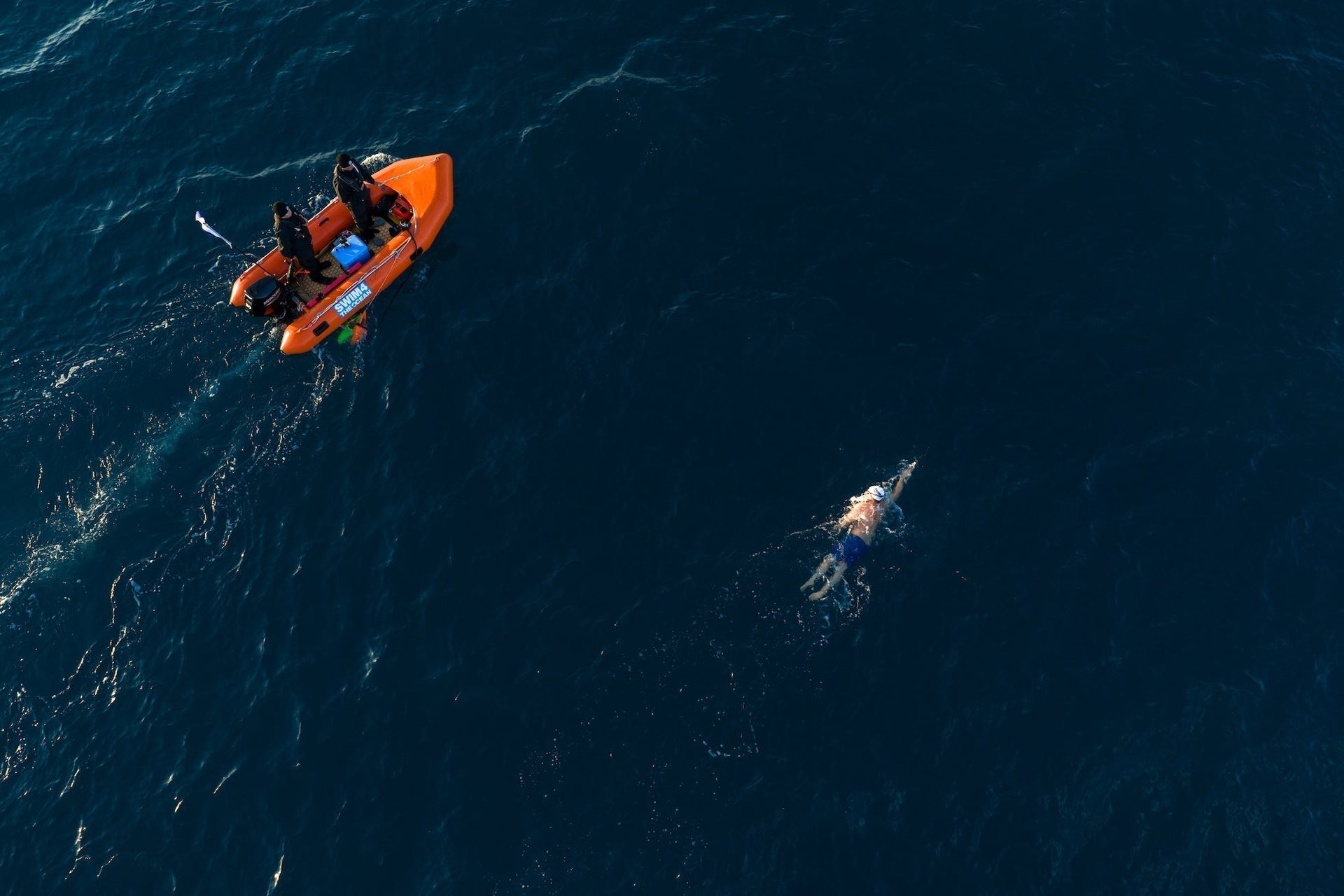
After rounding Cape Palliser into the Cook Strait— one of the most testing stretches of water in the world—Jono Ridler is swimming stroke after stroke towards the finish line of the biggest challenge of his life.
For almost three months, this has been his rhythm. Wake up, stretch, boat trip, swim for three or four hours, boat trip, rest, stretch, boat trip, swim for another few hours, boat trip, sleep—day by day eating up the 1400 km from the North Island’s tip at North Cape all along the eastern seaboard to the island’s southernmost extent at Wellington.
To keep going, he counts his breaths, following a repetitive pattern and letting go of any thoughts. The technique usually tips him into a flow state, where the half-hour stretch between breaks can feel like a single minute. Other times, the slog feels harder. There’s pain, intense effort, a mental spiral.
The first week, back in January, his skin blistered with sunburn. The salt-soaked hours ulcered his lips and tongue. When bad weather and currents slow his progress and cause delays, self-doubt creeps in.
But every so often the ocean provides reminders of what this swim is all about. A school of shiny, slender kahawai circling him in the water, and then larger, muscular kingfish joining the orbit, curious about this strange fish. From the support boat, which takes Jono to his mark each day—the GPS-logged spot in the ocean he left off the day before—there have been occasional sightings of penguins, turtles, orcas, whales, even the high sickle tail of a marlin slicing the surface. “It’s moments like these that help to bring you back to why you’re doing this in the first place,” Jono says.
 More than 50,000 people have signed Live Ocean’s petition, calling on the Government to end bottom trawling on all seamounts – at home and on the high seas – by the end of 2027, and to activate a quick transition away from bottom trawling entirely. Photo: Josh McCormack.
Why is he doing it? Partly, because no-one has done it before. If he succeeds, this will be the longest unassisted staged open-ocean swim ever completed, meaning Jono swims without a wetsuit or watch, wearing only togs, goggles and a swim cap.
 Jono has been supported throughout his mammoth effort by a dedicated crew who ensure his safety and allow him to rest when needed. Over the course of the journey, they will have come ashore over 120 times between swim shifts, including eight flagship stopover days. Jono is often welcomed by mana whenua and local community members eager to meet him and bring words of encouragement. Photo: Josh McCormack.
His underlying motivation is the ocean itself. The animal encounters on his journey south have been awe-inspiring, but much more wildlife teemed in these waters just a few generations ago. “A hundred years ago, we would've been seeing whales and dolphins and sharks everywhere. The sea would have been rife with them,” says Jono. “I've been able to see a lot more than most people ever will, but even that is a small glimpse of what was once here.”
Jono only discovered long-distance swimming at 21—just over fifteen years ago. His love affair with the ocean began much earlier, as a child growing up in Tamaki Makaurau/Auckland. On weekends, his Dad, a keen surfer and surf-lifesaver, took the kids boogie-boarding on the city’s wild west coast beaches. In summer, they’d holiday somewhere up or down the coast, or on Aotea/Great Barrier Island.
There, at the island’s Karaka Bay, Jono once saw an enormous stingray gliding under the wharf. And one magical evening, his family watched tiny fish zip through the bioluminescent water, leaving glowing green trails in their wake. “I think if you spend enough time in an environment, then you can’t help but care,” he says.
In 2022, while planning a 100 kilometre swim from Aotea back to mainland Auckland, Jono began to wonder how he could make the effort mean more than just a record. Thinking back to those formative nature experiences on Aotea, he joined forces with Live Ocean to create Swim4TheGulf in 2023, a campaign to raise awareness about the declining health of Tīkapa Moana, the Hauraki Gulf.
Thirty-three hours of non-stop swimming later, as Jono staggered ashore in the dark to a cheering crowd at Auckland’s Campbell’s Bay, he wondered how much further he could go—and more importantly, how many more people he could reach with his conservation message. “How could I do something really, really big that touches the entire country?”

 Jellyfish continue to be a defining feature of the final stretch of the journey to Wellington, including those of the barbed-wire variety. Jono is working hard to navigate them while managing the itch of old stings and multiple new stings. Photos: Josh McCormack.
New Zealand has 15,000 kilometres of coastline. We are an ocean nation–but our waters face mounting pressure. Jono has focussed his swim on one simple call to action; ending bottom trawling.
Every year, New Zealand fishing vessels scrape trawl gear across nearly one hundred thousand square kilometres of our seafloor. Their heavy metal doors crunch over sand and reef, corals and seaweeds, scooping up a vast and indiscriminate array of marine life before emptying the nets of squirming creatures onto their decks for sorting and export. Outside our waters, we are the only nation still trawling on the high seas of the South Pacific.
Jono believes the first step is banning bottom trawling in the ocean’s most fragile places—underwater seamounts, where thousand-year-old corals and sponges grow slowly in the dark alongside strange plants and animals found nowhere else. From there, he hopes the method can be phased out entirely.
It won’t be easy. Around seventy percent of the fish caught commercially in Aotearoa New Zealand comes up in bottom trawl nets, or from mid-water trawl gear dragged within a metre of the seabed. But stopping something so entrenched, Jono believes, could open the door to bigger changes in how we look after our oceans.
“None of this is an attack on commercial fishing or commercial fishermen,” he says. “But we're taking too much out of the water, and we're doing it in ways that are destructive and indiscriminate. Bottom trawling is kind of the major culprit.”
 Jono enjoys a moment of calm early on. The conditions between Northland and the final stretch of the east coast of Te Ika-a-Māui/ North Island of Aotearoa have become more challenging as the swim progresses south, bringing strong winds and heavy swells into the Cook Strait. Photo: Josh McCormack.
Jono is 1100 kilometres in and counting, with less than 100 kilometers to go. As he powers towards Te Whanganui a Tara/Wellington, his stamina is increasing. He can now swim as much as six hours in a session, slogging through nine hours on a good day. Though the self-doubt is still there, every successful stretch buries it deeper. The end is in sight.
Still, almost every day there’s a shark sighting from the boat. When the water’s murky, and he can’t see past his fingertips, the thought of pointed fins and sharp teeth constantly plays at the edges of his mind. His wrist tendons niggle, and his shoulders hurt. Overcoming the fear and pain requires both routine and belief.
“If you want to do something that's big, commit to it, and have a really strong reason for why you're doing it. And then just make sure you show up every day.” As he swims onwards, Jono is propelled not just by determination, but by love.
“When I'm in the ocean, I feel alive. I feel a strong sense of connection to the world—not needing to extract from it, or get a return on investment, just appreciating that we are part of something that is so much bigger. I wish everyone could realize how special it really is.”
Follow Jono Ridler’s swim, and sign the petition to end bottom trawling here.


Swimming the length of Aotearoa’s North Island, Jono Ridler is taking the long way around to spotlight what’s happening beneath the surface and call for an end to bottom trawling.