
“Just get on with it,” Neill Simpson tells me across the kitchen table, eyes fixed on mine and well worn hands folded in front of him. “If you wait for people to cross every t and dot every i, you’ll lose your enthusiasm. Occasionally you get a slap on the knuckles, but that's about all.” Neill’s not speaking in a Fast Track, get-on-with-it-and-build-a-big-mine kind of way. He’s a botanist, and he’s talking about conservation. And life, really, after I’ve asked for advice. “Yes, and volunteer, volunteer, volunteer,” adds Barb Simpson brightly. She’s a teacher, fellow conservationist, Neill’s wife of 57 years - and the animated to his softly spoken.
When you mention Barb and Neill to anyone in the conservation circles of the Tahuna Queenstown community, they nod with a smile. Most have planted trees or hacked at gorse alongside them, and many have come under their guidance. Their home bears evidence of a full but harmonious existence. A sketchpad, a piano which Neill still plays, shelves of records and classic books from the annals of botany and mountaineering. Out the back, they’ve built a lean-to called The Eyrie, a tribute to a hut in the hills with views out to the Remarkable range. At 80 and 92 respectively, Barb and Neill still get up the mountain; skis for Neill, snow shoes for Barb. From their sun-drenched table, we look out beyond the jumble of native plants on their property, across the lake at the spray of pine trees behind Queenstown.

 Above, a lifetime spent in close, reverent observation of the natural world. Photo: Dee Gerlach, Below, volunteers plant native trees under the watch of the Remarkables range. Photo: Whakatipu Reforestation Trust
Thousands of years before the crowds and the ski resorts, the Wakatipu basin was cloaked with native bush. Beech, kahikatea, mānuka, kowhai, a medley of alpine scrub - all thrumming with the birds who made them home.
Over time that forest was burnt and balded, and then came the day someone tossed a few handfuls of fast-spreading exotic conifer seeds across the hills. ‘Queenstown could be mistaken for the Swiss alps!’ people said with a hint of pride, while ecologists put their heads in their hands and the seeds continued to spread with the wind.
 Barb, unstoppable, leaping streams in the backcountry.
Long before settling in Queenstown, there was adventure to be had. Barb’s life collided with Neill’s at the Wanganui tramping club in the mid 60s, when, as he remembers it, “a vivacious, blond, blue-eyed girl burst onto the scene introducing herself and asking questions, usually very direct.” For the young Barb, here was an intrepid, plant-loving adventurer, ten years her senior, leading long expeditions down to the South Island.
They fell in love and married in ‘68. There were weeks spent in the mountains at a time, bivvying on ledges, hunkering down for storms. They climbed Malte Brun, the Minarets, Mount Aspiring; peering into remote and immense corners of our national parks where even today, trip reports are scant. “Oh yes, that’s Barb,” says Neill, pointing at an old photo of a bronze-legged girl bent double under the weight of two enormous packs, mischief in his usually thoughtful expression.
“We took our first bulge into the bush, didn’t we?” laughs Barb, “and all three boys after that. There was a lot of feeding babies in the bush, trying to wash reusable nappies in the river and dry them over the fire. Bulky things!” It’s not hard to imagine the bubbly young tramper of Neill’s memory—she is still vivacious and straight to the point, with a kind gaze and a broad, easy smile.
And then there was the botanising. Barb and Neill were members of the Wellington Botanical Society, and with up to thirty others at a time would roam the hills, searching for rare species, scribbling notes, taking photos. Neill had loved plants since he was a kid—a love that has grown only more resolute with age, and one which is evident in the gentle way he handles each little seedling under his care. “Eventually it just takes over your life,” he admits, “You keep going into the bush, or into the alpine, which is where I like to be. It’s just like being up amongst your friends.”
The urge to protect, Neill says, was always in the background. “We had the feeling that this whole area is our place. It's like having a home, isn't it?” he asks, eyeing me steadily again. “You want to look after it.”

Left: “I could do this all day,” says Neill as he squats, and sure enough, he spends much of the afternoon tending to seedlings close to the ground.
Right: Neill in his beloved alpine over half a century ago, near the summit of Ruapehu.
Conservation isn’t always popular, especially in small industry towns. The Simpsons had wanted to live in their beloved mountains, and eventually opportunity brought them there: to Spring’s Junction, a tiny village west of the Lewis Pass where Neill got a job as a ranger.
He shakes his head now, remembering the Forest Service announcing a new technique: clear felling, leaving one seed tree per hectare (“A ridiculous suggestion.”). For his work looking at joining two national parks, he and his workmates copped abuse from the local community; forestry industry and farmers alike. “And these were farmers who had been our friends!” adds Barb. A lesson, perhaps, in the challenges of standing up to the forces of commerce.
Then, Neill landed a job supervising the development of the new Remarkables ski field road. They were moving to Queenstown, pines beware. When the Simpsons arrived in town in the 80s, they were some of the first to pick up on the problem, though there was only a smattering of the invasive conifers on the landscape. They were also some of the first to act on it.

 Barb: “You just start something off because that's what you like doing or that's what you want to see done. And then people come and join in and it's those people that make it all worthwhile.” Photos: above, Whakatipu Reforestation Trust, below, Will Nelson.
“You could walk through them and see dying tussock and dracophyllum, so you knew what was going to happen. Although people thought we were mad,” says Neil with a sigh. In their march across the land, exotic pines suck massive amounts of water out of the soil, elbowing out any remaining native species and their winged inhabitants in the process. It was clear to the Simpsons that they were going to start smothering the alpine areas as well. But there was hardly a cent for the cause.
Unsurprisingly, they got on with it anyway, planting native trees and shrubs everywhere they could; around their house, on public land and on the fire-ravaged and once-thriving Pigeon Island. They rallied volunteers and advocated for pine and pest control, built tracks, started one trust (for the islands) and then another, the Wakatipu Reforestation Trust, which covered the whole basin.
Barb and Neill started with what they had: their hands, some seedlings, a dogged attitude. They started a movement that has swelled into a nursery, support from local council and landowners, and an army of volunteers.
 Barb relishing the barefoot joy of arrival at backcountry digs - in this case, the old Colin Todd hut on the flanks of Mt Aspiring.
In 2024 the Wakatipu Reforestation trust planted its 100,000th tree. 100,000 acts of hope and persistence. Neill and Barb have clocked up countless awards, for Neill the Allan Mere Award for meritorious services to botany and a Queens Service medal, and for Barb a Kings Service Medal.
“I've been thinking back on a number of things lately, as you do when you get older,” says Neill quietly. “And it's the people. It’s the people who come in on these projects that make everything worthwhile.” A blue-breasted tui streaks past, lands at the bird feeder outside and bears down on the tiny bird already there, scaring it away. “They’re bullies aren’t they,” says Barb, tutting. She’s waiting for the little silvereyes to come back.
Alongside the years of planting, Barb, with the spirit in which she had climbed peaks and washed nappies in rivers and sat out snowstorms in sagging tents, was also teaching generations Wakatipu High - first as a teacher, and then as head of outdoor recreation.
Forty years of running camps, wetland replantings and winter solstice tramps through frosted beech, ending with freezing swims and hot Milo back at school. Barb’s life, it’s becoming clear, has been dedicated to cheerful, tireless service. “I think my mother gave me that attitude,” she says, hands wrapping around her steaming mug. “She raised us on her own, but still found time to help others.”
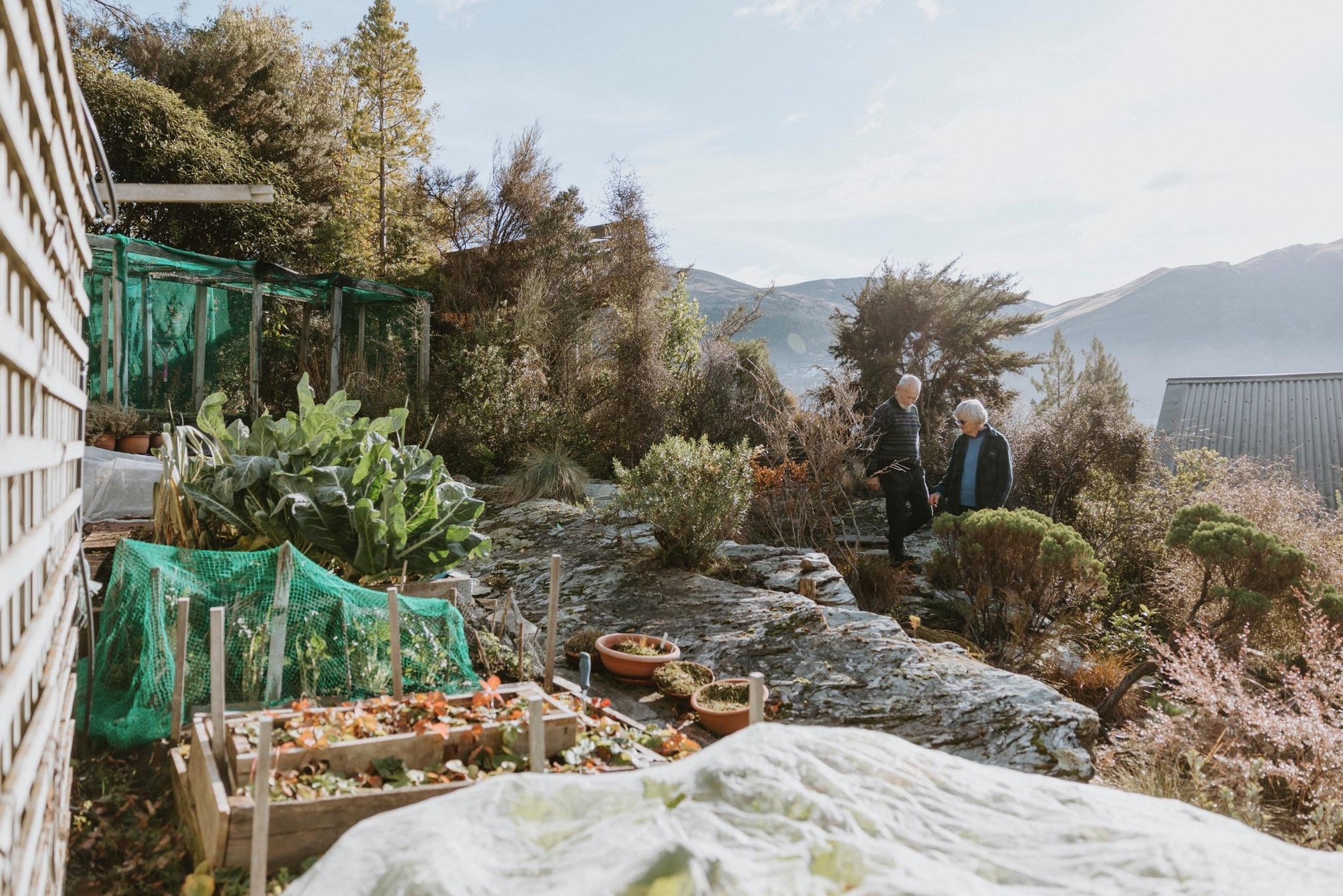
 Walking through Barb and Neill’s garden is wonderfully slow, as they point out the plants which thrive, those which were brought back from the brink of death and others which attract tiny native bees. Photo: Dee Gerlach
Down the road the next morning, at the last community planting day for the season, Jean Malpas Nursery is clattering with activity. If you were to fly overhead, you’d see a vibrant stronghold of indigenous diversity - rows of plants from seedling to adolescent, guarded from the neighbouring sea of conifers by sturdy knitted hedges.
Volunteers stand huddled around a table of seedlings. In the early winter light, breath rises as steam, and gloved, hooked fingers pry weeds loose. Someone has clambered up high and is hacking at the hedge with vigour. Through the hubbub weave Barb and Neill, answering questions and pausing to deliver gentle instruction.
Neill bends down to clear some weeds from a tiny totara seedling, pointing out some baby kowhai on his way down. “We love this place, and we just want to protect it, basically,” he says from his crouch, when I ask about the future. “That’s always been there, but it's only gotten stronger with time.” Struck by this simple philosophy, watching him brush weeds aside, it occurs to me that perhaps goals needn’t be complicated to be visionary.
And the long and happy marriage? They look at each other and grin. “Don’t sweat the small stuff,” Barb tells me firmly, laughter in her eyes. “And give the other person space. We’re all different.”
Retirement is not something Barb and Neill are particularly interested in. The pines remain a force to be reckoned with, but with the groundswell that now surrounds the Simpsons, the Wakatipu basin stands a chance at being thickened with natives once more. And when it is, the land will be humming a boisterous thank you to two people who took their enthusiasm and just got on with it.


Georgia is a writer and documentary filmmaker based in Ōtautahi Christchurch, as well as a self-professed compulsive community project starter. When she's not working, you'll usually find her on an adventure way outside her comfort zone.